Facebook

Friend us on Facebook

Monday, March 2, 2015

This Billboard Cheers If You Walk By It Instead Of Drive

From Fast Company:

A typical health-related billboard tries to sell you something—a gym membership, weight-loss surgery, a lower-calorie snack. But this conceptual billboard does nothing but cheer if you happen to walk by instead of driving in a car. The faster you walk or run, the louder the crowd screams.
"It's just something I do myself when I'm out jogging," says designer Sarah Weigold. "I imagine that I'm this big Olympic star running around with a crowd cheering me on. It's my sort of motivator. So I just made that into a real thing."


Because it's a simple motivator, Weigold thinks that it might be a little more effective than trying to convince people to make major lifestyle changes at once. "I wanted to make something really little, instead of weekly targets of so many hours," she explains. "It's something that you wouldn't feel guilty about not achieving. You can just take a few seconds and be slightly better, rather than falling short of a massive target."Though the design is a concept, Weigold says that it wouldn't be difficult to build. She compares it to existing speed sensors on roads. "If someone's going over the speed limit, it throws them a sad face. If they're going under, it shows a happy face. The technology is definitely there."

She envisions the design fitting into a larger program that would connect people for community support as they exercise. "For me, it was all about making people that their actions were significant," she says. "In the short term, it's a cheering crowd. In the long term, it was grouping people together so that their little bit of effort adds up to something."
The design is one of a growing number of ideas to repurpose the ubiquitous billboard for something other than advertising. So far, we've seen billboards that can make clean drinking watertrack air qualityhouse the homeless, and advertise art instead of products.

Friday, February 27, 2015

Tubbs Hill trail improvements ahead of schedule

Thanks to an exceptionally mild winter, upgrades to the east side trail of Tubbs Hill are well ahead of schedule. Initially, work was expected to be completed by June 30. Coeur d’Alene Trail Coordinator Monte McCully this week said work will be complete by the end of next week.

The project includes leveling slopes, smoothing the trail, eliminating outcrops, construction of retaining walls and placement of gravel in areas prone to puddle with water during wet conditions.
“It’s been so warm and dry that we’re are way ahead of schedule,” McCully said. “The crews have been hitting it hard and are nearly finished.”
Tom McTevia, a physically challenged Coeur d’Alene man, was instrumental in the improvements to the trail—which begin at the base of Tubbs Hill on the east end off 11th Street and continue up about 1,500 feet.
“These improvements will make such a big difference as far as accessibility for people who might otherwise not have been able to enjoy the beautiful trail,” McTevia said.
McTevia first approached the city years ago to express the need to smooth the trail and make it more accessible to people of all ages and physical abilities.
The $50,000 project is funded with a $29,000 grant from the Idaho Department of Parks and Recreation and a $21,000 grant from Avista Corp.


Photo: Tom McTevia, in wheelchair, ventures down the Tubbs Hill trail as crews from Trio Construction Inc. smooth the pathway.

Thursday, February 19, 2015

Four Corners/BLM Corridor Open House

The second open house for the Four Corners/BLM Corridor plan is Wednesday, the 25th of February, 6-8pm at the Library Community Room. The plan includes a commuter trail along NW Blvd and an 8 acre bike park for cyclocross, short-track mountain bike racing, and some skills park features. Please spread the word and show your support for improving our bicycle friendliness here in Coeur d'Alene. 

Tuesday, February 17, 2015

New Law that could mean fewer trails!

A recent law introduced in Idaho could mean fewer new bike paths in the Gem State.
Senate Bill 1044 would restrict the use of eminent domain and prohibit it from being used to acquire land for bicycle trails, paths and greenways, unless they run next to an existing highway or street. This would hinder the ability of cities and the state to construct bicycle paths and trails. 
The vote happens on Tuesday, February 17th. Speak up now and ask your leaders to oppose this bill!
Thanks for taking action to protect bicycling.
—The PeopleForBikes Team

Wednesday, January 21, 2015

Cycling Sins (1936)


Road Demons

Road Demons

by bikeyface
Pothole season is in full swing here.
Road Demons
Drivers are concerned about potholes because of potential damage to their cars. But I see potholes differently.
Road Demons
Gravel or road debris may not even register with drivers except for the outside chance of a cracked windshield. But all I see is:
Road Demons
Sometimes I report issues to the city.
Road Demons
And they are generally quick to close the case.
Road Demons
But sometimes I still hear the demons taunting me...
Road Demons
bikeyface | January 21, 2015 at 12:06 am | Categories: InfrastructureRoad Conditions | URL:http://wp.me/p27FRL-Fv

Friday, January 16, 2015

Friday, January 9, 2015

Shop Blocked

SHOP BLOCKED

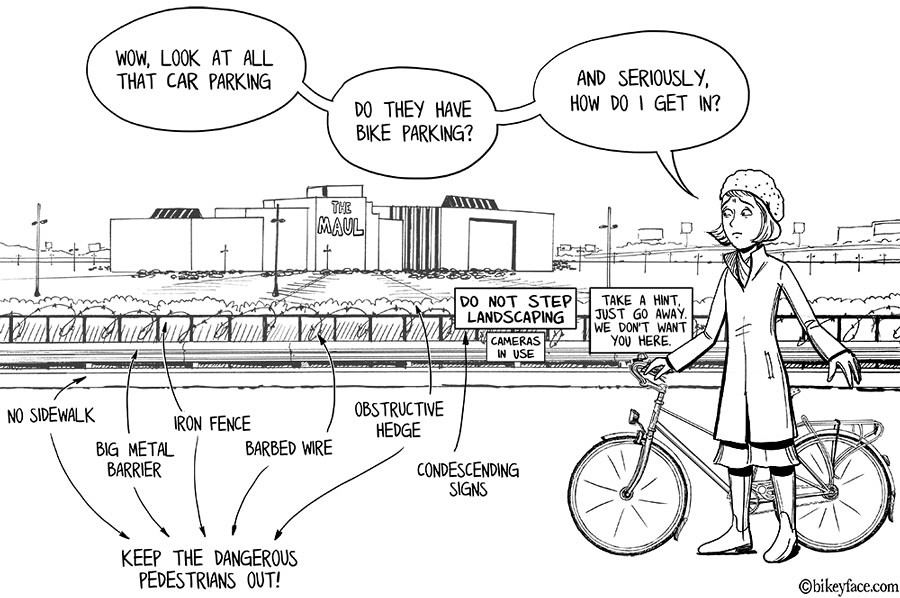
As I was shopping this holiday I went to a mall. And it suddenly occurred to me that, for some reason, I hadn’t gone to a mall in a very very long time.
Main Street
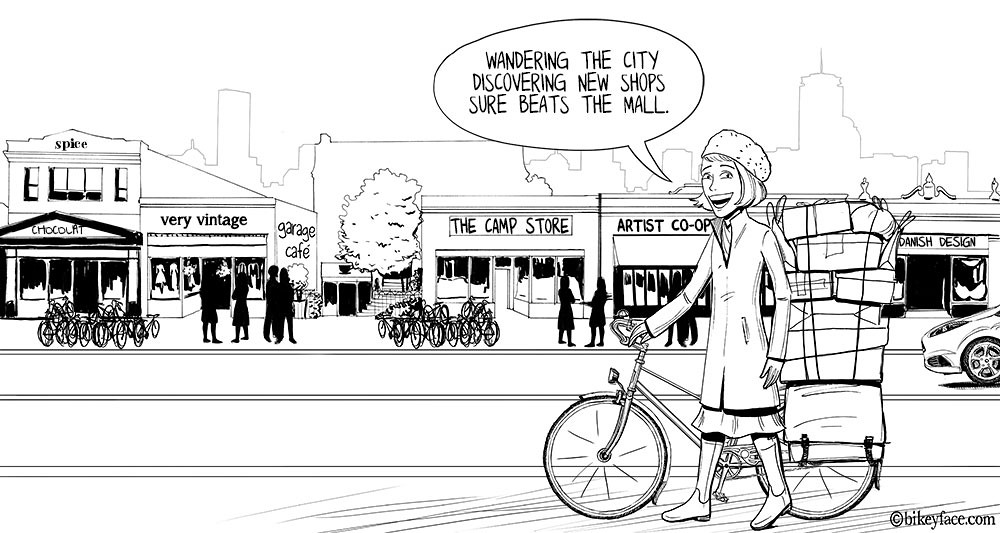
It’s one of those little lifestyle shifts that has happened with biking. I find myself almost exclusively patronizing small neighborhood shops.
Main Street


But that makes sense. When you’re walking and biking why go to shopping areas whose entrances send the message “KEEP OUT!”?

Friday, November 21, 2014

Idaho Communities Rethink How Roads Fit

By: Teya Vitu November 10, 2014

Americans aren't driving as much as they used to, according to transportation planners who visited Boise for a discussion about public space.


Across the country, vehicle miles traveled, or VMT, have declined 5 percent per capita

from 2000 to 20012 and 8 percent in the 2006-12 time frame. Even in car-centric Idaho,
the rate dropped 2 percent since 2000 and 1 percent since 2006. One group driving this
change is the Millennials, many of whom no longer see getting a first car at age 16 as a
rite of passage.

“Since 2006 and the recession, total VMT has declined in every state,” said Jim Charlier,

president of Charlier Associates, a Boulder, Colo., multimodal transportation planning
firm. “This is the first time this has happened. We've had increases in traffic since the
1920s.”

Commercial truck traffic increased by 30 percent in the 2000s.


Charlier said “walk-ability” is catching on with developers and home-buyers.


“Urban living is not about tall buildings. It’s the lifestyle,” Charlier said. “In the 2000s, people are moving from the suburbs into neighborhoods. Idaho has a lot of opportunities, from Boise to Bonners Ferry. Mixed-use neighborhoods with walk-ability can happen in a small town.”

Back before the car and even into the 1920s, “everybody worked toward building a better community,” said Gary Toth, director of transportation initiatives at the Project for Public Spaces, a New York City planning, design and educational organization focused on creating public spaces.


This gave way to freeways, parking lots that engulfed streets and buildings, and uninviting architecture that featured blank walls along sidewalks.


“This happened because we became focused on high-speed mobility,” Toth said. “We lost touch with our community. We need to move away from high-speed mobility.”


Charlier’s and Toth’s talks were part of Idaho Smart Growth’s reception for a three-day

Community Mobility Institute put on by the Sonoran Institute in partnership with ISG, the Idaho Walk Bike Alliance, and other local partners. These entities are partners in the New Mobility West program, a four-state initiative that provides communities across the Rocky Mountain West with tools and resources to improve their transportation systems by creating connected neighborhoods and more vibrant downtowns.

The Nov. 5-7 institute brought community leaders from Cascade, Lemhi County, Bonner County, Sandpoint, Post Falls/Coeur d’Alene, Twin Falls, Kimberly and Wood River Valley to Boise to gain insights on how to work with transportation departments to improve communities.


“One of the messages we’re conveying in the workshop is the rules have changed. You have to be aware of them,” Charlier said.


Idaho communities learned that transportation has a broader purpose than moving vehicles.


“Each community came willing to understand how to better connect transportation, economic development and community development,” said Clark Anderson, director of the Sonoran Institute’s Rocky Mountain Program.


The institute drove home the point that communities need to get more strategic with transportation investments in an era of decreasing transportation funding as well as changing dynamics in housing and retail toward more walkable streetscapes.


“They are looking to create transportation systems that are serving a wider range of users,” Anderson said. “The connections they are making need to make sense in an economic development sense.”


Each community drafted an action plan at the institute on how to apply the concept of increasing economic development with strategic transportation investment, said Jillian Sutherland, the Sonoran Institute’s project manager.

Friday, November 14, 2014

Sharing

Sharing

by bikeyface
Sometimes when I see "Share the Road" on signs I think there needs to be a silly cartoon character to go with the message:
Sharing is Caring
Don't get me wrong, sharing the road is obviously a necessary thing. But on a sign it's a little simplistic. It isn't actually clear what type of sharing is supposed to happen- that's left open to interpretation.
Sharing is Caring
Perhaps there could be more "Bicyclists May Use Full Lane" signs. We can leave messages about sharing (and squeaky cartoon characters) to the kids.

Tuesday, October 28, 2014

The new wonder drug? Cycling, some advocates say

The Nickel Tour: Cycling has positive impacts both for cyclists and non-cyclists alike, helping to reduce pollution and congestion and improving health and economic factors with just two wheels.

Cyclists are ready to let you in on a little secret: cycling makes both you and your community happier and healthier. That’s right: cycling has positive impacts even on non-cyclists.
(You’re welcome).
In a new report commissioned by British Cycling, Dr. Rachel Aldred of the University of Westminster points to data around the world that points to the benefits of cycling, certainly for the cyclist yes, but also for cities and communities that make significant investments in cycling infrastructure.
“The fantastic thing about investing in cycling is that it can generate benefits in a range of policy areas. Whether the goal is quicker urban journeys, improving life chances for low income people, revitalising town centres or reducing the growing burden of non-communicable diseases cycling can be part of the solution,”said Aldred in a statement about her study.
Let’s look at the money first.
For one, more funding for cycling could save the National Health Service around £17 billion, according to Aldred’s research, which calculated the savings within 20 years if residents of urban England and Wales cycled and walked as much as their cycling-happy counterparts in Copenhagen.
Cycling for a commute or to run errands means people get their needed exercise while getting from A to B and back.  A 30-minute commute to and from work would add up to 300 minutes of exercise per week. Considering the 2008 Health Survey for England found that just one in 20 adults was meeting the minimum weekly recommendation for 150 minutes of moderate intensity exercise, bike commuting seems a fairly shameless step (pedal?) toward a solution.
Riding a bike also means fewer cars on the roads,which means less carbon. Alder found that “shifting just 10 percent of journeys in urban areas from car to bike would reduce air pollution and save 400 productive life years.”
Need more economic arguments?
The report also found that streets with protected bike lanes saw up to 24 percent greater retail sales than similar streets without protected lanes, according to 2014 research from NYCDoT. And the benefits are felt across economic income levels: increased cycling would provide a 25 percent increase in mobility for the poorest British families, making it easier to access jobs and reliably get to and from employment centers.
If money is not compelling, consider what a switch from car to bike would do for congestion.
Cycling saves a third of road space compared to driving. And that’s just in traffic lanes. When you consider you can fit 10 to 12 bikes in the parking space of one car, the argument for making room for bikes in compelling.
A bicycle trip is also much more predictable in length of time than a car trip–a benefit to cyclists, but also to other drivers. Again look to New York’s dedicated bike lanes, and you’ll find the city’s car and taxi trip times either remained stable or even decreased in they city’s central business district.


Then there’s the happiness factor.
Both younger and older cyclists get more exercise and have a greater sense of independence than those who do not ride a bike, according to Aldred’s report.
In her studies, she found that more than two-thirds of Dutch people aged 55 to 74 get at least 30 minutes of exercise five times a week, mostly through cycling. Even among Dutch people aged 80-84, more than 20 percent say their preferred method of transit is cycling. Cycling keeps older Dutch residents active, socially connected and healthy.
And for Dutch children, nearly half of them (49 percent of primary school children) ride to school.
Those not riding also benefit from better bike infrastructure, in the form of safer streets.
“Studies show people feel safer on routes separating them from busy motor traffic, for example, involving separate infrastructure or quiet streets,” Aldred writes.
When people switch from driving to walking or cycling, injuries decrease. One study found that while switching from driving to cycling or walking may pose a greater risk of injury to the individual making the switch, they become less of a threat to those around them. And improved infrastructure for bikes and pedestrians, separated from vehicular traffic can reduce the risk cars pose to other road users.
Whether you are swayed by finances, health, congestion or just plain happiness, the British Cycling report makes the case for investing more heavily in bike infrastructure and in promoting cycling across the broad range of a population.
“We only have to look to Denmark and the Netherlands–countries that regularly top surveys on being the happiest and healthiest nations in the world – to see what a transformative effect cycling can have,”British Cycling Policy Adviser Chris Boardman said in a statement. “This is about creating better places to live.”

Wednesday, October 1, 2014

What biking's gender gap really says about America

The Nickel Tour: We know that there’s a big gender gap in cycling in the US, but this issue sheds light on other big issues we face as a country.
In recent years there’s been overall major support for biking among Americans, but women make up only a quarter of all bike trips in the United States.
Earlier this year, major bike share programs released data showing a glaring gender disparity among bike renters in New York, Chicago, and Boston. Women riders accounted for an average of 23.5 percent of overall rentals across these cities.
The raw data in these studies points pretty blatantly to the existence of the gap. As with any study however, the numbers themselves aren’t as important as where they come from, or as what we choose to do with them.
So let’s take a closer look.
For starters, the reasons behind many women’s reluctance to biking has been well documented.Elizabeth Plank at Mic writes the gender gap can largely explained by a mix of “women’s aversion to risk, women’s clothing, economic and time poverty, as well as sexual harassment.”
Women frequently cite safety as a major concern for cycling on the road. Lacking infrastructure and aggressive drivers are among several major risk factors that many women weigh in deciding whether to bike or not.
Beyond traffic safety, personal safety is on the line as well. Grooming and getting “office ready” post-ride keeps many women off bikes. And whether they’re wearing work fashions, cozy weekend gear or “cycling chic” clothing, many women are subjected to sexual harassment while biking.
Beyond those issues, and a long list of traffic concerns, we land on the issues of time and money—the two categories into which seemingly all other factors fall. We know that on average American women make less money than American men, so women need to spend more time working to make even close to an equal wage. They also frequently have more increased responsibilities at home compared to their male counterparts, hence, less time.
For many women, using a bike as a major mode of transportation just isn’t efficient for their lifestyle. Forplenty of others, biking is just the right fit. Whether the majority of women want to bike or not isn’t the issue. The issue is working to eliminate the frequent barriers to biking so that any woman who wants to do it can if she chooses.
That’s a long road. But the data, at least, serves as a reminder of the strides we still need to make, and at best, offers some opportunities for action.

Monday, September 15, 2014

How do you get more people to obey a pedestrian signal?

Have a dance party!


https://www.facebook.com/video.php?v=712275525521367&fref=nf


Wednesday, August 27, 2014

The Cities That Spend The Most On Bike Lanes Later Reap The Most Reward

Investing in a network of fully separated bike lanes could save cities huge sums in the long-term. But too little investment in wimpy infrastructure could actually decrease enthusiasm for cycling.


For every dollar spent to build new separated bike lanes, cities could save as much as $24 thanks to lower health care costs and less pollution and traffic, according to a new study from researchers in New Zealand.

"At the moment in most car-dominated cities, it’s easy to justify spending transport money on new roads as a response to increasing car use, despite the negative impacts this has on the environment and people’s health now and in the future," says lead authorAlexandra Macmillan. "We wanted to explore some policy choices that were realistic, affordable, transformative and healthy."

While there's already research backing up the facts that biking makes us happier,more energetic, better able to concentrate, less fat, and generally healthier--and that bike lanes make more people ride, and even boost local business--this study may be the first to look at how different types of bike infrastructure investments pay cities back later.

The researchers looked at Auckland, New Zealand, which is currently not a particularly bike-friendly place, and used computer simulations to model different scenarios for new bike-related investments, including regular bike lanes, lanes shared with buses, and fully separated lanes.
They found huge differences: If the city built a network of separated lanes and slowed down traffic speeds, it could increase cycling by 40% by 2040, but adding a few lanes in a few places might only increase bike traffic by 5%. The more people ride, the more the cost savings would add up for Auckland--the biggest factor being a reduction in health care costs. A smaller investment would have little impact at all; the city is so bike-unfriendly that major changes are needed.

In cities dominated by cars, a small increase in cycling tends to lead to more biking injuries and deaths, making other people more afraid to ride. The way to overcome that problem, the researchers found, is to make a bigger commitment to better bike lanes.
"We found that significant infrastructure investment is needed to overcome this dampening effect of fears about cycling safety; that high quality changes to main roads and local streets are the best place to start for cities with low cycling and high car use; and that these investments can have benefits an order of magnitude greater than the costs if you get them right," says MacMillan.
Though the study focused on Auckland, the researchers think that the general principles would apply to other cities where cars rule the road. "Auckland is very similar in design and transport patterns to many US cities, so we expect our findings to be relevant to the US," MacMillan explains. The exact savings would be different; the study wasn't trying to predict exact numbers, but show how different scenarios compare to each other.

The study is already beginning to influence policymakers in Auckland, and the researchers hope that it will continue to make a difference. "The tide is turning, I believe, in New Zealand and in many other countries that have neglected the bicycle in the last two decades," says Alastair Woodward, a co-author of the study.

"It makes sense in so many ways to bring back the bike, and this is happening. But only slowly. We hope our study, and others like it, will strengthen the arm of policymakers who are trying to shift the status quo."
For the original article click here

Monday, August 18, 2014

THE SUMMER OF DEMOS: ONE-DAY PROTECTED BIKE LANES SWEEP ACROSS AMERICA

Michael Andersen, Green Lane Project staff writer
A temporary demo during StreetsAlive! in Fargo, N.D., on July 15. Photo: Dakota Medical Foundation.


This is what a tipping point looks like.
Around the country in the summer of 2014, community groups across the United States have been using open-streets events and other festivals to give thousands of Americans their first taste of a protected bike lane.
From small-town Kansas to the middle of Atlanta, communities (many of them inspired by last summer's successful $600 demo project in Minneapolis) have been using handmade barriers and relatively tiny amounts of money to put together temporary bikeways that spread the knowledge of the concept among the public and officials.

"Every traffic engineer who touches a street in Oakland, they were all out on their bikes checking it out," said Dave Campbell of East Bay Bike Coalition, who led the creation of maybe the year's most beautiful demo on Telegraph Avenue there. (Click to enlarge -- it's worth it.)

"We wanted this to look awesome," Campbell said in an interview. "People would see this and go,That's f------ awesome. I want that on my street."

Here are some of the results from around the country:

Lawrence, Kan.: 9th Street, April 25

Photo: Matt Kleinmann.

Oakland, Calif.: Telegraph Avenue, May 8

Photo: Bike East Bay.
That's Oakland Mayor Jean Quan having a great time riding a bike share bike in a protected bike lane.
Advocacy group Bike East Bay also created a video of their impressive Telegraph setup, which used traffic chalk for the shark-tooth yield markings, plus one gallon of exterior green paint and a homemade bike stencil to mark the lane's entrances. (Paint was possible because the local business district was already planning to pressure-wash the street afterward.) Here's a full manual on how Campbell and friends did it.

Minneapolis, Minn: Lyndale Avenue June 8

Photos: Nick Falbo, Alta Planning and Design.
In Minneapolis, the advocacy campaign Bikeways for Everyone not only created a sequel to last year's project, they added a demonstration of a protected bike lane intersection laid out personally by designer Nick Falbo of Alta Planning and Design:

Atlanta, Ga.: Auburn Avenue, June 21-22

Photo: Robin Smith.

Denver, Colo.: Arapahoe Street, June 25

Photo: Bike Denver.

Mountain View, Calif.: California Street, July 24


St. Paul, Minn., Wabasha, July 24

Photo: Matthew Dyrdahl.

Oakland, Calif.: Temescal Street, July 6

Photo: Bike East Bay.
On both Temescal and Telegraph, Bike East Bay created simple, attractive barriers by flattening cardboard boxes, rolling them into cylinders with binder clips at the top and bottom and setting them on top of standard orange traffic cones. They also used 600 feet of four-inch-wide reflective white traffic tape, which cost 29 cents a foot, and (in lieu of green paint to mark the entrances) two 4' x 20' x 5 mm black rubberized floor mats, spray-painted green, for $170 each.

A few tips from the experts

Give people a reason to enter the demo lane. This is especially important at an open-streets event that doesn't have car traffic on the street in the first place.
"Many people ignored the lane and stayed on the street," wrote Alyssa Gullekson of the Dakota Medical Foundation in an email about a July 15 pop-up in Fargo, N.D. "At the next event in August, we will route bicycles into the lane so that that is the route is assumed most appropriate. We will also have an individual directing people into lane to draw more attention to it."
Try to encourage conversations as well as the demo itself. In Mountain View, Calif., Safe Mountain View engineered longer conversations by offering a bike raffle, a free ice cream voucher for people who completed surveys and bike-themed coloring pages to entertain children "so the parents could talk to us with fewer distractions," organizer Cherie Walkowiak wrote.
Do everything you can to get city staff there. For Campbell of Bike East Bay, the most rewarding moment of one of his demos was when a city engineer working on a permanent protected bike lane came by to watch people using the temporary one.
"He's been designing this and analyzing it and talking to other people," Campbell said. "And all of the sudden he's standing there living it for a moment. You could see his facial expression has changed."